


Our Campervan


Which Van - There's So Many!
Choosing the right vehicle for travelling is very much a personal choice, and one which needs careful research, considering a whole host of different things from layouts to size (does size really matter?), to type of vehicle to facilities on board.
There is no "one size fits all" and compromises have to be made!
So...here is what we did and how we came to choose the van we are in now and the reasons why, and the modifications and changes we made to the camper van to suit our needs.
I will be including links to the sites and businesses we used
The Plan
We had the long (and it was long! I would say in excess of 20 different makes and models) list which we needed to whittle down to something more manageable.
FIRSTLY - accept that compromises have to be made. Unless you have an endless supply of money and you can have designed and built whatever you want regardless of the cost (I don't think there are many of us in that boat!), then compromises will need to be made
SECONDLY - Remember your budget! It's great to get caught up in the excitement of looking at motorhomes and camper vans but you do not want to break your finances for going too extravagant - and as you will learn there is no need to go over the top when you make your purchase.
THIRDLY - What type of motorhome do we want. Coachbuilt (such as Swift Voyager or Coachman Travel Master etc) or a van conversion (known colloquially as a 'campervan'). Having hired one of each (see our ADVENTURES page) , we had decided that the camper van was the type we wanted to go with.
So, our plan was very simple. We made a list of what we considered to be essential and what we considered to be desirable and what we considered to be a luxury.
ESSENTIAL
Large enough for 2
Seating area
Cooking facilities
Toilet and shower
Solar Panels
Storage Space
Auto Gearbox
Canopy
Gas supply
Underslung water
EU Clean engine
Diesel powered
DESIRABLE
Bigger berth
Hab Air Con
Cycle Rack
Underslung Gas
LUXURY
RV Size
Electric bed
Induction hob
Drive away awning
Separating toilet
Hybrid Engine
Armed with our list - we searched through what we had already seen and then got the lost down to 3 or 4 suitable vehicles.
Then we set about looking for these particular vehicles - and I can honestly say it made the who task infinitely less daunting and we began to see our way through the many different motorhomes and campervans there were out there
We still travelled around lots of different dealers viewing the vans we were interested in (and YES we did get distracted and look in others as well!!!)
What we found was, that once we had set out eyes upon a particular camper van, we kept coming back to it. We liked the look, the layout, it ticked most of our boxes and reviews were on the whole pretty good.
So there is was - we were looking at an Autosleeper Warwick - at this point either the Duo or the XL.
The Warwick series ticked most of our boxes. As I said earlier, compromises have to be made and whilst it didn't tick them all, it was pretty close.
Now all we had to do was find one in our budget range.
New Or Second Hand
Again this is down to personal choice but my opinion is :
Buy new and you lose a lot of money as soon as you drive it away and there's all the niggles and issues that will need to be fixed/resolved
BUT - you have peace of mind. Manufacturers guarantee (far superior than any warranty) and the benefits of a brand new vehicle. You are the first owner/driver/user
Buy secondhand - as the saying goes 'you're buying someone else's problems' - yes this is a major consideration BUT I think you get better value for money, the niggles have already been sorted, the engine is run in and the vehicle is set up and ready to go.
One thing I have learned (and yes I know it's a little more expensive) - you get a lot more peace of mind buying through a reputable dealer than going private
Buy private by all means - and there are many many great deals to be had. BUT bear in mind that it is 'Buyer Beware' - get any vehicle properly checked out before you commit to buy.
We decided on second hand - mainly budget reasons but also for the points I raised above.
We found an Autosleeper Warwick Duo for sale through a dealer. We made an appointment to view the vehicle and on the day we set off to go, an alert came up on Autotrader informing us that a Warwick XL had just come on the market.
We were travelling about a 90 minute journey to see the Duo and the XL was showing literally 10 minutes down th road from where the Duo was!
We believe that this was fate working in our favour.
We viewed the Duo and it was a very nice vehicle.
We went to see the XL (10 minutes down the road)
We just looked at each other and said - "this is the one"
So we spoke with the dealer - ROVE MOTORHOMES at Gunby - I can definitely recommend this company. They are genuine people who really do take an interest in you as a person and nothing is too much trouble (no we are not getting paid to say this!)
We purchased our Campervan :
2018 Autosleeper Warwick XL, diesel engine, Euro compliant, automatic gearbox, large enough for 2, fixed beds (can be singles or made into a double), cooking facilities, toilet and separate shower area, solar panel, canopy, underslung LPG gas, solar panel, lots of internal storage - just about everything from our list PLUS it has hydraulic auto levelling system and satellite TV system
The price was just in budget!
Once we picked up the camper van we knew we had 'struck gold'. This was now our van. Our adventures could begin.
Next was to modify and upgrade our van to suit both off grid and on
grid travelling.


Upgrading
Electric System
We have our camper van, we have ticked off most of our essentials list and now we need to look at upgrading/ changing and modifying our camper van to make sure it can do what we want it to do.
So - the plan (now we have the van) is to travel across the UK, Europe and the wider world and see the sights, make the memories, live the life we have been given!
The first thing we looked at was off grid capability. With travelling comes the planning of where we are going to stay and if we are not off grid capable, then this list of places is limited to official campsites and places with the appropriate facilities to make it work.
What did we have in our camper van already? The answer to this is the standard 90Ah lead acid battery, charger for solar and alternator, along with electric hook up when available.
Research taught us that a 90Ah lead acid battery, effectively has 45Ah of useful usage. I am not an expert in these things and I don';t know the intricacies of why this is, BUT I knew that 90Ah - or worse still 45Ah is of no use to us. If we were to go off grid we wouldn't last the day if we had all electric appliances running. A solution was needed!
Following a trip to the Caravan and Motorhome Show at the NEC in Birmingham we had the chance to speak with many people about off grid solutions.
We finally settled with Lithium Pro who worked through solutions with us and came up with with the system we have now had installed in our camper van.
There are many other companies who provide a similar service and they are all great and will offer their advice and assistance. Again it was down to personal choice why we chose Lithium Pro.
Having been through our plan and what we wanted to do, we chose :
Victron 3Kva Off Grid Kit and
Megavolt 628Ah 12V lithium battery
This was a massive upgrade to our electrical system and it was not cheap. However, you get what you pay for, and we have learned this lesson over and over again!
This meant a full change to our electrical system. New chargers were needed (provided in the kit), including a solar charger (provided in the kit).
We were having an inverter installed (again all part of the kit) which can handle 3000 watts.
I must say that the whole inverter thing really amazes me. Transforming the 12V supply into 240V is something of a miracle!
I'm no expert at electrical installations, so with the assistance of Glen from Lithium Pro, he put us in contact with Stu from Sunnyside Up Solar.
Stu! What a guy. He came along in the freezing cold weather and installed our system in our camper van without issue. He knows exactly what he is doing and had the installation fully fitted and working in a day and a half.
With the new kit installed - we were off grid capable. No need to hook up.
As part of the installation we have a full monitoring system. The Victron Energy Display Panel shows your usage as you are using it.
You can monitor what power each of your electrical appliances are drawing and how this affects the battery life. This helps enormously to understand what is good/not good to use.
As an added benefit, the installer (Stu) and those at Lithium Pro can look at the system in real time and can advise/help if a problem arises.
This system really has made a huge difference. Off grid living is a real thing for us now.
628Ah is HUGE - and when the sun is shining this is being charged. When the engine is running, it is being charged.
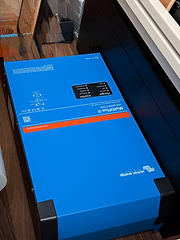
Our Victron 3000 watt inverter

Water System
Being in a campervan, and likewise with a motorhome, the on board water is stored in a tank. Now I know a lot of people choose not to drink the water from the tank, preferring bottled water instead, however when we were looking at going to Morocco and discovering the water quality issues there, we invested in a filter system to overcome this. This same filter system works for the water in the tank here as well.
Firstly - please make sure that you do regularly empty and clean the fresh water tank. There is absolutely no point in being complacent and thinking that a filtration system will sort it out. Some basic 'housekeeping' is good practice and making sure the water in the tank is as clean as it can be is always the best way to start.
So we invested in a Watersprint Solo Nautic II filter system and a Flostream 3-stage pre-filter.
The Watersprint Solo Nautic II was specifically designed for ships however it is compact and lightweight and easily works in a camper van or motorhome. It provides clean, drinkable, safe water - see the link to their information page for full details
We saw this product at the NEC and thanks to Penguin Kuranda we had the filter system delivered along with the inline Flostream 3 filter (for added filtration). This goes inline on the water filling pipe (the pipe you connect to the supply tap to the onboard tank of your campervan or motorhome) and removes any particles and sediments BEFORE the water is put through the Nautic II
This way the water into the campervan is a lot safer.
We have the filter connected to the cold tap in the kitchen. You can plumb it in so that all the water in the camper is filtered BUT this requires a lot more work (finding the pipes and the space to install the filter) and then the filter will have to be replaced a lot more regularly as all water is being filtered.
The only water we need filtered is out drinking water. We can shower and wash in unfiltered water without issue (unless you actively drink the shower water)
Separating Toilet
Going off grid means that we need to find ways to dispose of - yes, something we have to consider - Toilet Waste!!
I make no apologies for talking poo and wee for the next few minutes 😬
Ordinarily, supplied with the vast majority of Campervans, Motorhomes and caravans is the chemical toilet.
I'm sure we all know what these are - you put the blue liquid (or the green liquid as it is sometimes sold as these days) into the 'tank' and this deals with all the liquid and solid waste that is deposited in there.
When it is time to empty the waste container, you have what is known as "black water waste".
Black Water Waste can only be disposed of (legally) in a black water waste facility - usually found at campsites, or coach depots.
What you CANNOT do with black water waste, it throw it into a hedgerow, or down a standard drain or even down a conventional toilet. The chemicals must be dealt with properly at the proper facility.
We've done an information sheet covering this topic - follow this LINK
So there we have an issue in that you are limited as to what you can do and where you can dispose of the black water.
Enter the separating toilet. The magic of this toilet is that it separates the liquids from the solids. So, wee goes into it's own separate container and poo goes into it's own separate container - hence the name - separating toilet!
Each of the containers can be disposed of locally in rubbish bins, toilets or drains.
Why? Because there's no chemicals involved and it's no different to "filled nappies" and "dog poo" being thrown into the bin.
It's no different to animals pee-ing in the street and it going down the drain, and you can dispose of it down a normal toilet because there are no chemicals involved at all.
There is one consideration to take note of. It is one of "toilet odour"
Now, as the waste is separated, the odour is a lot less. I didn't believe this at first, but now I've used the separating toilet I can vouch for this 100%. The odour is a lot less!! But there is a slight odour nonetheless
After a lot of trial and error, we have found the perfect solution.
Sawdust (normal animal bedding sawdust, or sawdust from a sawmill if you happen to be able to get some) mixed with BIOCHAR.
Biochar is a lightweight (great for motorhomes and campervans), carbon rich charcoal-like substance made by heating organic waste. This along with the sawdust literally absorbs the odour.
Toilet smells practically gone!
So there we have it - a separating toilet all ready for the big adventure.